• Link to LinkedIn
  • Link to X
  • Vacancies
  • Corps Monitoring
  • Corps Intel
  • Corps Together
  • Colleague Login
  • Customer Login
Call the team on 0207 566 0500020 7566 0541
Corps Security
  • Home
  • Our Story
    • Our Heritage
    • Our Approach
    • Meet The Team
    • Accreditations & Awards
  • Our Services
    • Drone Security
    • Security Guarding
    • Security Monitoring
    • Security Consultancy
    • Integrated Security
  • Social Values
    • Social Enterprise
    • Our Values
    • Corps Together
    • Veterans Association
    • Veterans Association Membership
  • Case Studies
  • Work For Us
  • News
    • Latest News
    • Bulletins & Updates
  • Contact Us
    • Contact Details
    • Locations
  • Click to open the search input field Click to open the search input field Search
  • Menu Menu

Tag Archive for: Corps Consult

Posts

Navigating An Uncertain World
Corps Security Blog

Navigating An Uncertain World

In a world where the only certainty is uncertainty, security professionals face unprecedented challenges. The recent Global Risks Report 2025 paints a stark picture of our increasingly fractured society.

In partnership with Toro Solutions, The Institute of Strategic Risk Management and MX4 Foundation, Corps were proud to take part in this expert panel discussion hosted in January.

With representatives from the security industry, including our Executive Director Mike Bluestone and Director of Corps Consult Neil Shanks, we were delighted to take part in an extremely thought-provoking panel discussion. It which was moderated by Corps’ Sales and Marketing Director Andy Topp.

Together, the panel reflected on the crucial insights about the future of security and risk management from the Global Risks Report 2025 and debated the current challenges and solutions.

How has the security industry changed in 2025?

It’s clear that the world is changing at a rapid rate. Exacerbated weather events, increasing conflicts and the polarisation of society make vigilance a constant requirement. Risks are becoming more interconnected, unprecedented, and difficult to navigate. With heightened tensions and new methods of offence, there’s a multitude of factors the security industry needs to adapt to. The traditional frameworks and tools the industry has used in the past to understand and manage risks were designed for a different era. They are no longer fit for purpose in the modern day.

Treating physical and cyber security as separate fields is no longer appropriate. Attackers are now blending their tactics, using both physical and digital methods of offense. This new method requires a fundamental shift in how the security industry approaches all facets of security.

How are standards changing the security industry?

Martyn’s Law has the potential to mark a watershed moment for UK security, introducing mandatory requirements for physical security measures in events spaces to enhance public safety. The panel highlighted the need for clear, actionable standards for resilience. These standards must bridge the gap between cyber and physical domains, creating a unified framework that organisations can adopt.

Building resilience in security

The panel agreed that resilience is critical in an increasingly volatile world and businesses must consider three key factors:

  • What risks will most hurt?
  • What policies, processes, and training will prepare us?
  • How can we move from a reactive to a proactive approach to security?

The key to building resilience in security, is to undertake scenario planning. This helps colleagues pre-prepare their responses and build the required muscle memory. This testing should also be part of ongoing training.

How do we cultivate the next generation of security officers?

It’s important that the security field comprises more young people, women and diverse voices from a multitude of backgrounds to better represent the communities we protect. The panel talked about the fact that security is often seen as a second-choice career, rather than a first choice calling and this must change. The consensus was that the industry must unite and speak with one voice if it is to evolve.

Security providers need to create initiatives to attract diverse talent, invest in training and modernise perceptions of the industry to make security a career of choice. The next generation of security professionals must be agile and equipped to thrive in a converged, fast-changing world.

Ready to build a secure future for your organisation?

As one of our panel experts noted, “We’re in a Darwinian stage of evolution” in security. Companies that adapt will thrive; those that don’t, face heightened risks. It’s no longer enough to operate alone. Our industry must work as one to develop the right strategies, and work from an integrated mindset. This moves us from survival to adaptation.

Are you looking to enhance your security operations? We have the expertise, resources, and vision to help you succeed. Contact us today to learn how we can help protect your future.

February 17, 2025/by Corps Security
https://www.corpssecurity.co.uk/wp-content/uploads/2025/02/Navigating-An-Uncertain-World.jpg 700 1024 Corps Security https://www.corpssecurity.co.uk/wp-content/uploads/sites/8/2022/05/Corps-Security-Logo-Est-1859.svg Corps Security2025-02-17 16:39:352025-03-11 16:58:53Navigating An Uncertain World
The Eight Layers Of Security Preparedness
Corps Security Blog

The Eight Layers Of Security Preparedness

In our last blog, we looked at how businesses can measure a return on security investment (ROSI). In this blog, the team at Corps Consult, led by Mike Bluestone CSyP, turn their attention to the foundations of an internal security infrastructure, which can be driven by applying the eight principles of security. These principles will enable firms to develop an overarching defence mechanism to prevent, or at the very least, delay and deter cyber and physical attacks.

Internal and external measures

An organisations’ measurement of their own security preparedness can be taken once a comprehensive security system is in place. In addition to conducting internal tests, external specialists should also be used to further understand the effectiveness of physical and cyber-security measures.

For example, the cyber-security of zero trust security initiatives requires each step of internal IT platforms and systems to have verified defence mechanisms. This should be tested by using professional external security auditors, who can provide appropriate recommendations upon completion of a system audit.

External specialists can also develop measurable targets for security guarding services, and the security management of any organisation. This is important no matter your organisation’s size and is especially relevant to smaller teams who may lack the resources to conduct effective internal audits.

The eight principles of security programmes

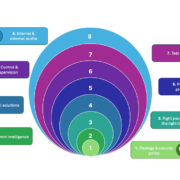
To set the tone for any organisational security programme, apply the eight principles of security. Together, they provide a well-managed defence system that deters attackers, and slows down any progress they could make:

1 – make sure there is a strategy and security policy already in place. This gives a baseline for an effective security programme and set of measures, as well as allocation of a security budget.

2 – ensure that the organisation concerned is in possession of correct intelligence on their threat landscape.

3 – allocate the right people to the right roles. For example, in terms of management and guarding.

4 – install appropriate technical means, including, access control, CCTV, and intruder alarms.

5 – focus on correct and easy to follow security procedures.

6 – Assign control and supervision to the best qualified staff.

7 – Regularly test and perform system drills.

8 – conduct regular internal and external audits and employ experts if the organisation cannot conduct audits internally.

Once these eight steps are in place, your organisation will develop a strong security and corporate culture. Input staff feedback loops like questionnaires on the knowledge of these layers and how each interacts with each other – like the strategy and whether it relates correctly to the current threat landscape. For example, businesses and corporations should be aware of the current threat landscape with increased protests and political unrest and have a strategy in place to protect staff and other assets.

The importance of security principles

By adopting and applying the eight principles in your organisation, a safe and secure business environment can be established. Going forward, regular security audits can detect and assess the level of security measures in place as well as the resilience of the staff security culture. If staff are unaware of the security procedures, the business can become more vulnerable, and at risk from attack from criminals, protestors, or in certain circumstances even terrorists.

Businesses and organisations that implement appropriate electronic and physical security measures, such as fencing, lighting, hostile vehicle mitigation, CCTV monitoring, robust access control and well-trained security officers will deter attackers. Equally, the installation of monitored intruder alarms and panic alarms can trigger fast responses by police and/or other security personnel.

These steps can help secure your business against attackers, but never forget the importance of your people and their contribution to the overall security culture. A layered security approach can help prevent and deter threats, but they’re only as effective as the team that follow your procedures. By making the security of your people a top priority you will in turn ensure the resilience of your entire business.

If you’d like to know more about Mike’s work and the advice Corps Consult can offer, read more about the service and make an enquiry.

Read the previous blog on ROSI to learn more on the metrics for success, and where to invest resources.


 

March 20, 2024/by Corps Security
https://www.corpssecurity.co.uk/wp-content/uploads/2024/03/The-Eight-Layers-Of-Security-Preparedness.jpg 700 1024 Corps Security https://www.corpssecurity.co.uk/wp-content/uploads/sites/8/2022/05/Corps-Security-Logo-Est-1859.svg Corps Security2024-03-20 09:00:432024-03-26 09:53:52The Eight Layers Of Security Preparedness
Understanding your return on security investment (ROSI)
Corps Security Blog

Understanding Your Return On Security Investment (ROSI)

Measuring a return on security investment (ROSI) can be a complex task for businesses, especially where small teams of employees are in place. ROSI allows businesses to identify gains, enhance user experience for clients and consumers, and ensure that their security model is improved on a regular basis. Mike Bluestone CSyP, executive director of Corps Consult, who heads up our department that provides expert advisory services on security risk management and resilience, offers the following advice when it comes to understanding your return on security investment.

The metrics for success

To understand ROSI measurement, the first step is to identify metrics for your organisation’s gains. These measurements need to be conducted regularly, but also require quantifiable means to understand the confidence of an organisation’s personnel. Essentially, firms need to monitor whether their staff are too relaxed on security procedures, and how confident they are regarding incidents and breaches. When you can measure these, you can gage the culture of your organisation, and future-proof it against hostile reconnaissance and attacks.

As well as monitoring incident detection to see what types of breaches are identified and how they are dealt with, the key to measuring effective ROSI is by also monitoring whether there are increases or reductions in incident reporting. Verified reductions will indicate an improvement in incident detection and confirm that effective, and proactive, procedures are in place.

Examine the strength of multiple security measures with routine checks on physical security measures. For example, physical penetration tests should be a top priority, as they identify how individuals may breach the premises and what layers of security need to be improved. Mystery shoppers are another example for retail areas; using covert customers to ask staff questions can indicate whether they are well-versed on taught procedures and know how to identify and report any suspicious behaviour.

These measures are effective because their outcome, whether positive or negative, ensures staff are well-practiced on necessary procedures. This makes their worktime and response awareness more streamlined and effective.

Invest in the right people and procedures

Enhancing user, customer, and staff experience also relies on outreach. Routinely interview your staff and provide questionnaires for team members working in the business.

To develop your own security model, you will need to apply proactive planning, and an outlined programme for your security measures. Regular drills, tests, audits, and feedback will ensure procedures are effective.

Your staff should be encouraged to stay up to date with current legislation and new technologies available. This doesn’t necessarily mean that your business requires a dedicated security manager, as a well-qualified facilities premises manager can also have oversight on security. For example, a member of the Institute of Workplace and Facilities Management (IWFM) who possesses the right level of security experience and qualifications can also provide the expertise required.

If your services are spread thinly, develop strong relationships with professional security advisors, who can advise on your contingency plans which are necessary to mitigate the impact of serious security breaches and emergencies.

It’s having the right people and procedures in place that will ensure ROSI. It can be too easy to think that investing in the latest security technology and systems will be enough. However, if your staff, security team, and management are unclear on your business operation and procedures, even the most advanced security system can be compromised. Remember, be proactive, strategic, and routinely test your plans, procedures, and planning.

If you’d like to know more about Mike’s work and the advice Corps Consult can offer, read more about the service and make an enquiry. The next blog on ROSI will explore the eight principles of security programmes.

March 13, 2024/by Corps Security
https://www.corpssecurity.co.uk/wp-content/uploads/2024/03/Understanding-your-return-on-security-investment-ROSI-.jpg 321 470 Corps Security https://www.corpssecurity.co.uk/wp-content/uploads/sites/8/2022/05/Corps-Security-Logo-Est-1859.svg Corps Security2024-03-13 13:10:292024-03-13 13:28:09Understanding Your Return On Security Investment (ROSI)
Martyn’s Law: Transforming The Role Of Security
Corps Security Blog

Martyn’s Law: Transforming The Role Of Security

Martyn’s Law, officially known as the “Terrorism (Protection of Premises) Bill”, is a draft bill which will change security’s function throughout the UK. The proposed bill is especially important at a time where events and festivals are increasing in popularity after the lockdowns of previous years.

King Charles III outlined the change to legislation during his King’s Speech earlier in November, framing its relevance around the increased threat of new technology for national security. His speech, which was part of the State Opening of Parliament, marks the key Government priorities for 2024. This means that the Government will consult on the bill as part of the introduction to the parliamentary process.

Why the law is needed

Martyn’s Law was spearheaded by Figen Murray OBE, mother of Martyn Hett, who was one of the 22 victims of the horrific 2017 Manchester Arena Attack. Six years on, Murray and her team are still fighting for better security measures at venues, helping to develop this bill in Martyn’s memory.

A year ago, she spoke at a Corps Security event on the topic at the Royal Opera House. During Murray’s speech, she prompted officers to think from the perspective of someone intent on causing harm, who is trying to detect building vulnerabilities. These thoughts could be integrated into counter-terrorism action plans akin to health and safety structures, that should involve well-informed staff and possible practice runs.

These ideas will soon become mandatory procedures. Martyn’s Law will introduce multiple requirements for organisations to better prepare their security teams for a range of terror and non-terror related prevention and response.

What the law includes

Martyn’s Law will qualify for any premises with a capacity for over 100 individuals. These areas are classed as the “Standard” tier.

Standard premises were initially outlined as requiring anti-terrorism training for staff, information sharing procedures, and a preparedness plan for potential attacks will need to be in place. These plans could include first aid or specialty training for staff prior to emergency services’ arrival. However, the government is currently consulting on the requirements of the standard tier, to ensure there are not overwhelming burdens on smaller premises.

Further duties apply for “Enhanced tier”, establishments with a capacity of over 800. These will require heightened measures, risk assessments to help develop thorough security procedures, a shift of security culture to be more diligent of potential threat, and enhanced security technology. These can be implemented through ‘reasonably practicable’ measures tests.

Once enforced, the law will change the landscape of day-to-day security measures for buildings we protect. The new constant and vigilant eye cast will heighten public safety measures, so attacks like the Manchester Arena can never occur again.

What’s next?

This law has been through multiple stages of development since its first draft was released in December 2022, after the Government consulted the public, terror survivors, local authorities, and security experts.

One major next step will be introducing a regulator, that monitors eligible premises’ compliance and advises them. This regulator will be equipped to address non-compliance, who can investigate any malpractice and sanction and offenders monetarily. They will likely be able to access all areas of sites, interview any staff, and could work with a police presence.

The Law is set to be introduced within the next calendar year. However, there is a possible change of Government during a General Election possibly between Autumn 2024 and January 2025. The recent ministerial appointment Rt Hon James Cleverly MP as the Home Secretary may also slow down the Law’s finalisation.

Stay up to date

Martyn’s Law is not final. It will require further parliamentary review and Governmental changes may totally transform it by the point that it is introduced to law.

To follow these changes, be sure to stay up to date with Corps Consult’s monthly Intelligence Updates, as part of our Corps Relay. These updates includes any developments on Martyn’s Law and what we can expect in upcoming months. The November update on the bill is featured on page 6.

Martyn’s Law is set to be a welcomed and comprehensive change to the security industry. Ensuring counter-terror training and emergency preparedness will save lives and serve public interest well.

December 1, 2023/by Corps Security
https://www.corpssecurity.co.uk/wp-content/uploads/2023/12/Martyns-Law-Transforming-The-Role-Of-Security.jpg 410 600 Corps Security https://www.corpssecurity.co.uk/wp-content/uploads/sites/8/2022/05/Corps-Security-Logo-Est-1859.svg Corps Security2023-12-01 14:15:092023-12-01 14:15:09Martyn’s Law: Transforming The Role Of Security
Achieving Efficiencies In Security And Resilience During Tough Economic Times
Corps Security Blog

Achieving Efficiencies In Security And Resilience During Tough Economic Times

Mike Bluestone MA CSyP FSyI, Chartered Security Professional, and Executive Director of Corps Consult

Against a backdrop of rising inflation, manifesting itself with increasing energy and employment costs, the challenges presented to businesses and organisations, whether in the public or private sectors, to maintain the edge in security and resilience is taking on a new and pressing meaning. Now is the time to review security measures by conducting Efficiencies and Resilience reviews. Doing nothing at this time is simply not an option. Indeed, it is not just economic issues that are prompting reviews, but time is short before the introduction of the long awaited ‘Protect Duty’ legislation, now anticipated in early to mid-2023.

The new legislation is expected to impose ground-breaking rules and requirements for securing publicly accessible locations and events. Whilst the exact details remain unknown, the indications are that businesses and organisations will be required by law to plan and prepare security measures which must be proportionate to the risks and threats and engage in thorough risk and vulnerability assessments. In short, security measures will need to be tight and fit for purpose, and the advice and planning for security measures will need to be conducted by suitably qualified professional persons.

One important expected outcome of the legislation will be to impose strict accountability for those with the responsibility for implementing security measures, and readers should bear in mind that these will be embedded in law, and thereby accompanied by penalties for any breaches of the new legislation.

As in the case of most challenges, the current set highlighted above, present an opportunity for reflection, change, and enhancement. Now is the time to pause, take a step back, and review existing security measures and pose the question: What can be done differently to deliver more resilient and effective security solutions?  There is room for optimism, since new security technology can offer different ways to deliver security solutions, which can often result in cost savings and efficiencies by complementing and sometimes replacing traditional guarding measures by for example, re-examining the posts deployment and shift patterns of security personnel. The outcome of a professional Security Resilience and Efficiencies review can also highlight relevant cost savings.

Navigating through this turbulent storm of change, namely inflation, increased energy and employment costs, and the impending new legislation, can all be eased by retaining qualified security professionals to conduct the reviews and submit detailed reports which will set out the necessary efficiencies and changes. We here at Corps Consult are Chartered Security Professionals with recognised qualifications and certification, coupled with extensive experience in delivering such reviews. It is important to start the process sooner rather than later. Global events will continue to be major influencers in the current economic climate so early action is advisable.

September 28, 2022/by Corps Security
https://www.corpssecurity.co.uk/wp-content/uploads/2022/09/Paying-The-Living-Wage-In-A-Cost-Of-Living-Crisis-Is-Still-The-Right-Thing-To-Do-1.jpg 410 600 Corps Security https://www.corpssecurity.co.uk/wp-content/uploads/sites/8/2022/05/Corps-Security-Logo-Est-1859.svg Corps Security2022-09-28 17:01:392022-09-28 17:09:59Achieving Efficiencies In Security And Resilience During Tough Economic Times

Latest News

  • Corps Security Appoints Non-Executive Director Kathryn FlemingFebruary 6, 2026 - 1:30 pm
  • Corps Security secures three-year contract with Neovia Logistics
    Corps Security Secures Three-year Contract With Neovia LogisticsDecember 10, 2025 - 3:28 pm
  • Corps Security Achieves Silver EcoVadis Award
    Corps Security Achieves Silver EcoVadis AwardSeptember 9, 2025 - 1:06 pm
  • Corps Security Awarded Prestigious Contract At The National Archives
    Corps Security Awarded Prestigious Contract At The National ArchivesSeptember 2, 2025 - 9:10 am
  • Chris Middleton Appointed Director At The Security Institute
    Chris Middleton Appointed Director At The Security InstituteJuly 21, 2025 - 9:58 am

Categories

  • Corps Relay
  • Corps Security Blog
  • Corps Security Press Releases

Archives

Our Social Values

We protect more than you think

There’s a lot more to Corps Security than you might expect. Yes, we are experts in security and we have over 166 years of experience. But we’re also experts in how to put sustainability and diversity at the heart of everything we do.

We are a Social Enterprise

>> ESG Report

>> Carbon Reduction Plan

>> Equal Employment Opportunities Policy

>> EDI Survey 24-25 Action Plan Report

More Information

Accreditations

Corps Security Accreditations

About Corps Security

Built on over 166 years of experience and a clear social mission, we provide specialist security services tailored to ensure the safety of people and property.
Our values are at the heart of everything we do, through the people we work with, the people we employ, the people we help and the planet we protect. Together we protect the things that matter.

Registered Office at 85 Cowcross Street, London EC1M 6PF.  Registered in England No. 03473589

Latest News

  • Celebrating 167 years of Corps Security February 12, 2026
  • Intelligence Update February 2026 February 10, 2026
  • Corps Security Appoints Non-Executive Director Kathryn Fleming February 6, 2026
  • 5 Minutes with Mark Taylor January 20, 2026
  • Corps of Commissionaires Retirement Benefit Scheme – November 2025 January 13, 2026

Corps Security Offices

  • England – London (Head Office)
    • Birmingham
    • Bristol
    • Crawley
    • Leeds
    • Manchester
  • Scotland – Glasgow
  • Wales – Cardiff
  • Northern Ireland – Belfast

Specialist Security Services

  • Drone Security
  • Security Guarding
  • Security Monitoring
  • Security Consultancy
  • Integrated Security
  • Case Studies
© 2026 Corps Security (UK) Ltd. All rights reserved | Designed by InDzine | Programmed and SEO by InDzine
  • Modern Slavery Statement
  • Terms and Conditions
  • Privacy Policy
  • Accessibility
Scroll to top Scroll to top Scroll to top

This website uses cookies to ensure you get the best experience on our website. By continuing to browse the site, you are agreeing to our use of cookies.

AcceptSettingsPrivacy Policy

Cookie and Privacy Settings


How we use cookies

We may request cookies to be set on your device. We use cookies to let us know when you visit our websites, how you interact with us, to enrich your user experience, and to customize your relationship with our website.

Click on the different category headings to find out more. You can also change some of your preferences. Note that blocking some types of cookies may impact your experience on our websites and the services we are able to offer.

Essential Website Cookies

These cookies are strictly necessary to provide you with services available through our website and to use some of its features.

Because these cookies are strictly necessary to deliver the website, you cannot refuse them without impacting how our site functions. You can block or delete them by changing your browser settings and force blocking all cookies on this website.

Google Analytics Cookies

These cookies collect information that is used either in aggregate form to help us understand how our website is being used or how effective our marketing campaigns are, or to help us customize our website and application for you in order to enhance your experience.

If you do not want that we track your visist to our site you can disable tracking in your browser here:

Other external services

We also use different external services like Google Webfonts, Google Maps and external Video providers. Since these providers may collect personal data like your IP address we allow you to block them here. Please be aware that this might heavily reduce the functionality and appearance of our site. Changes will take effect once you reload the page.

Google Webfont Settings:

Google reCAPTCHA

Google Map Settings:

Vimeo and Youtube video embeds:

Privacy Policy

You can read about our cookies and privacy settings in detail on our Privacy Policy Page.

Privacy Policy
AcceptDo not accept
Open Message Bar Open Message Bar Open Message Bar